Your Next Website Visitor Won't Be Human
More and more, the first thing to read your website is an AI agent acting on someone's behalf. It does not scroll, it does not admire your animations, and it decides in milliseconds whether to recommend you. Here is what that changes.
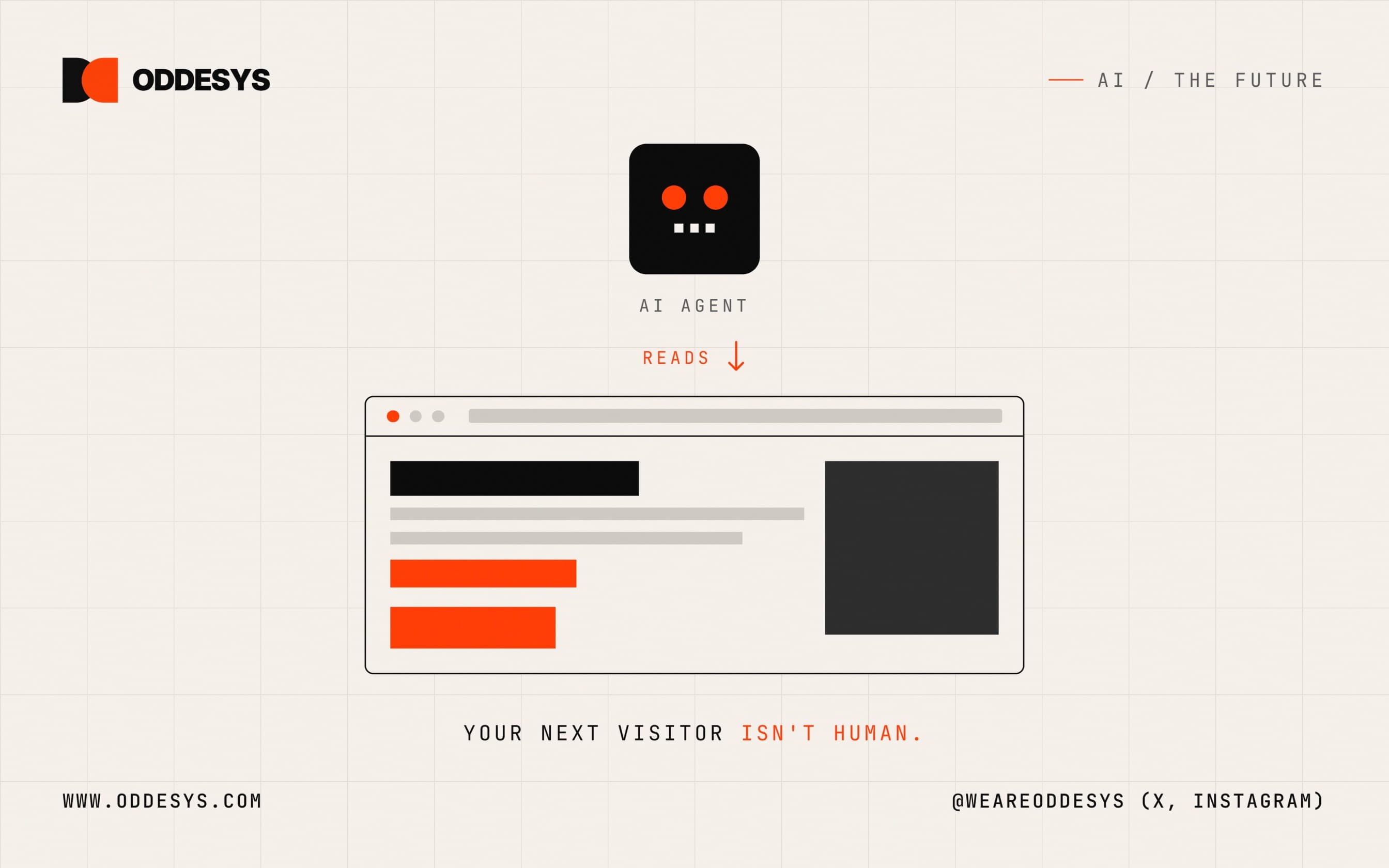
Picture the next person who needs what your business sells. In 2026, there is a growing chance they never open a browser tab at all. They ask an assistant. Find me a good option, compare these three, book the one that can do it this week. An AI agent goes out, reads a handful of websites on their behalf, and comes back with an answer.
Your website still got visited. A human just was not the one doing the reading.
This sounds like science fiction until you notice it is already how a real slice of people shop, research, and decide. And it quietly breaks a few assumptions that websites have been built on for twenty years.
The visitor that does not behave like a visitor
An AI agent reading your site is nothing like a person.
It does not scroll slowly and get charmed by a clever animation. It does not feel reassured by a big hero image. It does not give you the benefit of the doubt when the page is confusing. It reads the structure and the words, extracts what it needs, and moves on, often in less time than it takes a human to find the menu.
It is also brutally literal. If your pricing is locked inside an image, the agent cannot read your pricing. If your key facts only appear after a button click or a slow script, they might as well not exist. If your site is a beautiful fog of vibes with no clear statements, the agent has nothing to take away and nothing to recommend.
The uncomfortable truth is that a lot of websites are built to impress a human in the first three seconds and have very little underneath. That worked when humans were the only audience. It does not work for a reader that skips straight to the substance.
A human forgives a confusing website and pokes around. An agent just leaves and recommends whoever was clearer.
SEO was about being found. This is about being understood.
For years the game was ranking. Get to the top of the results page so a human clicks you. That game is not over, but a second one is starting next to it, and it has different rules.
When an AI agent is the reader, you are not competing for a click. You are competing to be the source it trusts and quotes. It is less about where you sit on a page and more about whether your site states, clearly and verifiably, what you do, who you serve, what it costs, and why you can be believed.
People have started calling this answer engine optimization, as opposed to search engine optimization. The label matters less than the shift behind it. The winners will be the sites that are easiest for a machine to read correctly, not the ones with the flashiest front door.
The irony is that this rewards the same things good communication always did. Clear claims. Real specifics. Saying what you mean instead of dressing it up.
So do we stop designing for humans? No.
Here is where it would be easy to overcorrect. Strip everything back, write for the robots, and ship something cold and ugly. That is the wrong lesson.
Humans are still the ones who buy. The agent shortlists, but a person almost always makes the final call, and when they do, they look. A site that reads well to a machine and feels dead to a human has just traded one failure for another.
The actual job is harder and more interesting. Build something that works for both readers at once. Beautiful and clear to a person, structured and honest to a machine. Fast for both, because neither has any patience. The good news is that these goals fight each other far less than you would think. Clarity, speed, and real substance serve the human and the agent equally. It is mostly the empty flash that serves neither.
What this means in practice
If you are building or refreshing a site or app in 2026, a few things are worth getting right.
Put your important facts in actual text, not buried in images or hidden behind interactions. What you do, who it is for, what it costs, how to take the next step. A machine should be able to read all of it without guessing.
Make the structure honest. Headings that describe what follows. Pages organized the way the information actually relates. This helps a human skim and helps an agent parse, at the same time.
Be fast. A slow site loses impatient humans and times out on agents fetching it at scale. Speed is not a nice to have here, it is the price of being read at all.
And do not abandon design. Make it genuinely good, in service of clarity rather than in place of it. The brand still has to land for the person who shows up after the agent points them your way.
Where this is going
We do not think websites are disappearing. We think the audience is quietly doubling. For every human visitor, there is increasingly a machine reading on someone's behalf, and the sites that win will be the ones built for both without compromising either.
That is the lens we bring to web, app, AI, and UI/UX work at Oddesys. Clear enough for a machine to trust, good enough for a person to choose. If you want your site to be ready for the visitor who is not human, that is a conversation we find genuinely exciting. Come say hello at oddesys.com.