We Messaged 30 Local Businesses Through Their Own Contact Forms. Here Is What Came Back.
We sent the same short customer inquiry through the contact forms of 30 local businesses and tracked the replies for 14 days. Nineteen wrote back, only six within a day, and eleven produced nothing at all. That spread is where customers are won and lost.
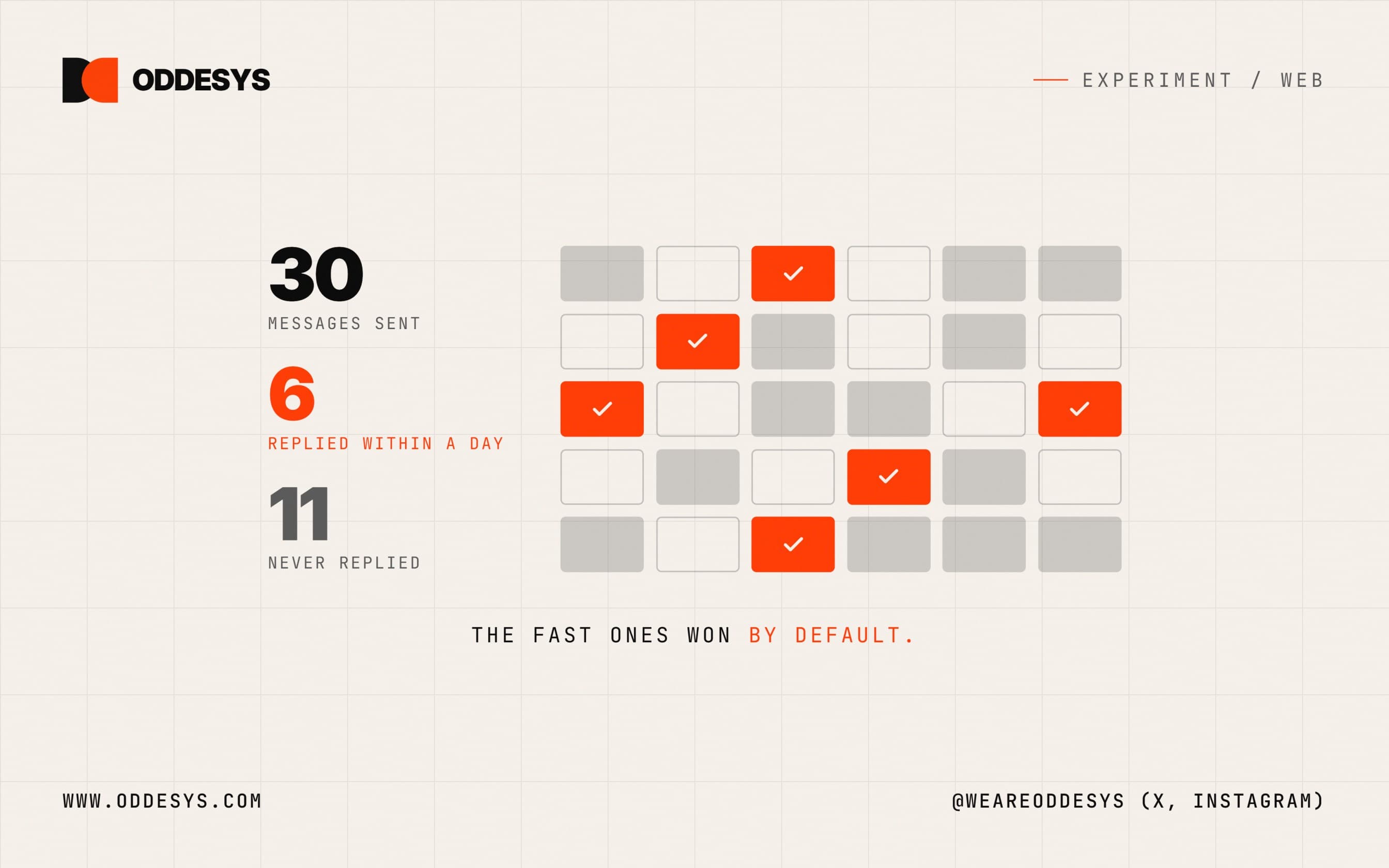
We ran an experiment. We wrote one short, genuine inquiry, the kind a real customer sends every day. A few plain lines asking about availability and rough pricing, signed Sam. Then we sent it through the website contact forms of 30 local businesses, one in each of 30 different trades, and watched what came back for 14 days.
Nineteen replied. Eleven never did. Only six replied within 24 hours.
The median wait was about two days. The slowest reply took twelve days, which in customer time is forever. The most expensive thing we found was not bad service. It was silence.
What we actually did
The message was deliberately ordinary. No tricks, no fake urgency, no secret test phrases. Just what a real buyer types at nine at night: we are looking for this service, are you available in the next couple of weeks, and what does it roughly cost.
Then we waited and kept score. We measured only the things a real customer can actually see from the outside: did a reply come, how long did it take, and did it answer the two questions we asked. We did not call and we did not chase. We behaved like a customer with options, because that is what every customer is.
What came back
The replies fell into two piles, and the gap between them is the whole story.
The good ones came fast and did the work. The strongest reply landed about ten hours in: three open dates in the coming two weeks, a list of packages, and real prices. Everything Sam needed to say yes, in one message. The quickest of all arrived about five hours after we pressed send. It was not polished. It just existed while the customer was still deciding.
Then the slow and thin pile. A reply that lands on day twelve is not a reply, it is an apology. One of ours arrived exactly there: a vague line, late at night, telling Sam to just drop by. No price, no timeline. A real customer would have booked someone else days earlier. And across all nineteen replies, only six actually answered both questions. The other thirteen were some flavor of call us, which quietly hands the work back to the customer, who usually does not bother.
And then there is the silence. Eleven inquiries produced no reply at all in 14 days. We cannot tell you why, and that is exactly the point. A form that quietly broke in a redesign, an inbox nobody has opened since the business changed hands, a message lost to spam, a note that was seen on a busy morning and buried by lunch. From the outside, every one of these looks the same. It looks like silence.
A broken form and a busy owner produce the same thing: nothing. The customer cannot tell them apart, and does not wait around to find out.
Your customer never sees the reason. They only ever see the result. So the reason does not decide anything. The reply does.
The math nobody does
Every one of those 30 messages was a customer holding money. Someone who found the website, scrolled to the form, typed out a question, and pressed send. Short of walking through the door, a lead does not get warmer than that.
Now run the numbers from the customer's side. Eleven of those people heard nothing for two full weeks. Several more got a reply so late and so thin that a real customer would have bought elsewhere long before it came. Only six got a real answer inside a day.
Which means the six businesses that replied within a day did not have to be the best in town. They won by default, because most of the field never showed up. A fast, clear reply did not need to be perfect. It just needed to exist while the money was still deciding where to go.
Five minutes to find out if your form is a black hole
You can run this entire experiment on yourself before lunch, and you should.
Message yourself from your phone. Open your own website the way a stranger would, fill in the form with a real question, and press send. If nothing lands in your inbox, you just learned, for free, what eleven of these businesses never did.
Check the spam folder. Form mail slips into junk more often than you would expect, and a folder you assume is empty is a folder you never open. If your test message is missing, look there before you trust the form.
Find out where the form actually sends. An old address, a previous owner's inbox, a plugin that quietly broke during a redesign. Any of them sends your form mail into nothing, and that wiring gets forgotten every time a site is rebuilt or a business changes hands. The form is only as good as the inbox on the other end.
Decide who owns the reply, and how fast. Not whoever happens to see it. A name, and a standard, ideally the same business day. Two lines with a real time and a real price beat a warm paragraph that shows up on day twelve.
That is most of the fix for most businesses. A fast, clear reply is the cheapest competitive advantage in local business, because the bar, as we just measured it, is sitting on the floor. And if your test turns up something broken between your website and your inbox, that is a small repair, the kind we genuinely enjoy. If you would like us to run the same test on your site, from form to inbox to reply, you can find us at oddesys.com.