Why Your Website Is Slow, and the 5 Fixes That Matter Most
Most slow sites are slow for the same five reasons, and none of them are mysterious. Here is what actually moves load time, and how to check yours in two minutes.
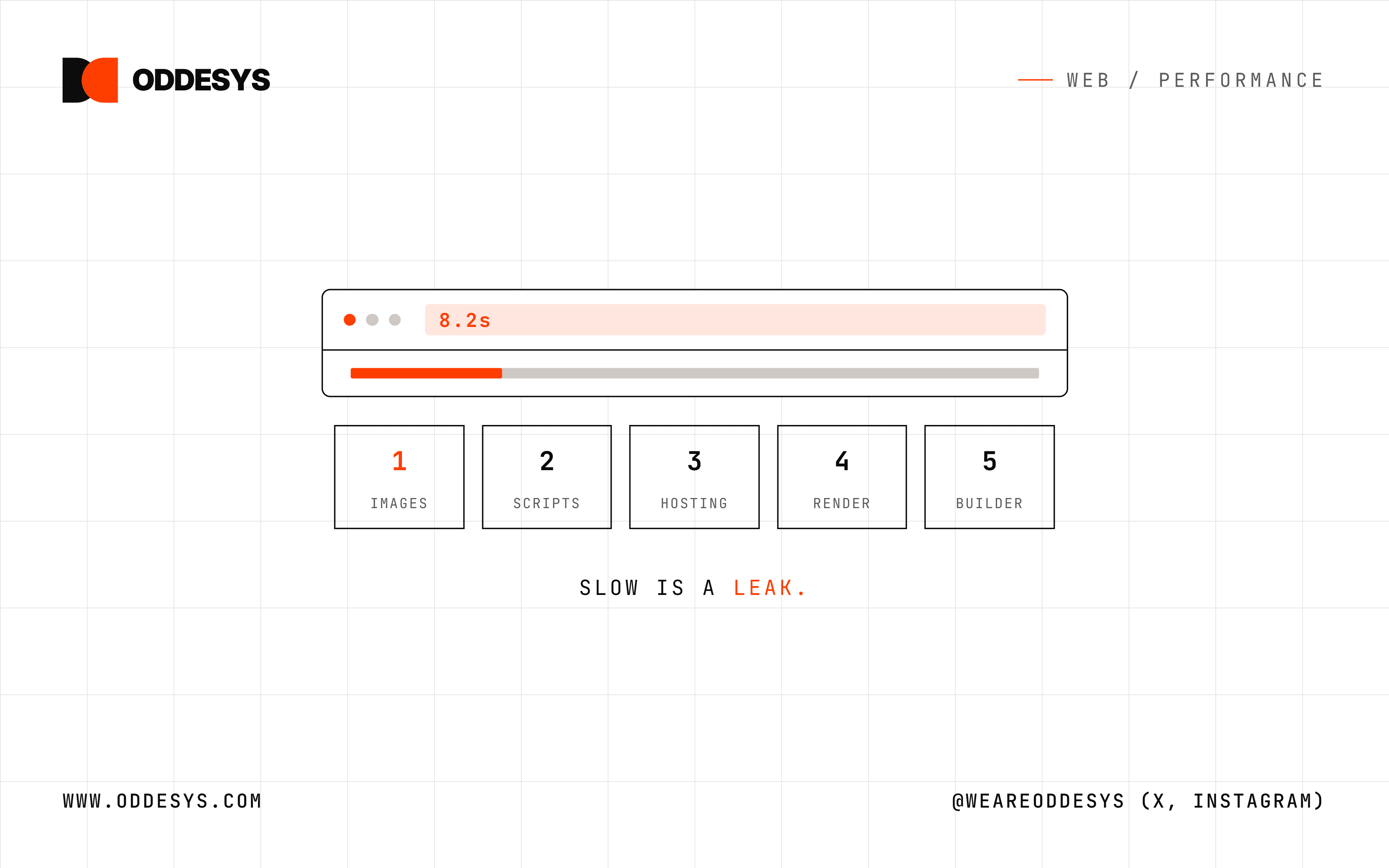
You probably think your website is fine. It loads on your phone, it looks good, you have stopped noticing the wait because you visit it every day and your browser has it cached.
Your customers do not have that luxury. They land on a cold page, on a worse connection than yours, holding a phone three years older than yours, and they decide in about two seconds whether to stay. A lot of them leave before your site has finished drawing itself, and you never see them in any report because they were never really there.
The good news is that slow sites are almost never slow for clever reasons. They are slow for the same five boring reasons, over and over. Fix those and you fix most of it. But first, find out how slow you actually are.
Do not guess, and do not trust how it feels on your own machine. Go to PageSpeed Insights from Google, paste in your address, and read the mobile score. It is free and it takes two minutes.
Ignore the single number at the top for a second and look at the timings underneath. The one that matters most for the human experience is how long until the main content shows up. If that is under about two and a half seconds on mobile, you are in good shape. If it is four, five, eight seconds, you are bleeding customers and you have been for a while.
Every extra second of load time is a quiet tax on every visit, every day, forever, and nobody sends you the bill.
Run the test before you change anything and write the number down. You want proof that the fixes worked, not a feeling.
Fix one: shrink your images
This is the big one. On most slow sites we look at, images are more than half the total weight, and usually it is one or two photos doing the damage.
The classic mistake is uploading a photo straight off a phone or a stock site. That file can be five or ten megabytes, sized for a billboard, and the browser has to drag the whole thing down before it can shrink it to fit a small box on screen. You are shipping a poster to show a postage stamp.
Resize to the size you actually display. A photo shown 600 pixels wide does not need to be 4,000 pixels wide. Use modern formats. WebP or AVIF cut file size by half or more with no visible loss. Compress before you upload. A free tool like Squoosh or TinyPNG will turn a four-megabyte image into a few hundred kilobytes in seconds. Do that to every image on the page and you will often cut total load time in half on its own.
Fix two: cut the outside tools you do not use
Open your site and count the outside tools bolted onto it. Analytics, a chat widget, a heat-map tracker, a cookie banner, a review carousel, two or three ad and retargeting tags, a font service, a popup builder. Each one loads code from someone else's server, and your page often waits on all of them.
The painful part is that you are now at the mercy of servers you do not control. If the chat widget's company has a slow day, your site has a slow day. We have seen pages where a single marketing tag, added and forgotten a year ago, was adding two full seconds for every visitor.
Go through the list and be honest. Are you reading the heat-map data? Did anyone open that analytics dashboard this quarter? Remove what you do not use. For what stays, ask whoever built the site to load it lazily, meaning after the page is usable rather than before. Most of these tools have a setting for exactly that.
Fix three: get real hosting and a CDN
Hosting is where business owners save the wrong fifty dollars. The bargain plan puts your site on a crowded server, often on the other side of the planet from your customers, sharing power with hundreds of other sites. When someone visits, every piece of your page travels that whole distance, every time.
A content delivery network, or CDN, fixes most of this. It keeps copies of your site in data centers around the world and serves each visitor from the one nearest them. The distance shrinks, the wait shrinks. Many good hosts include a CDN now, and services like Cloudflare offer a free tier that helps almost any site.
You do not need to understand the plumbing. You need to ask one question: is my site behind a CDN, and is my host actually fast? If your developer cannot answer, that is the answer.
Fix four: stop scripts from holding up the page
This one sounds technical but the idea is simple. When a browser builds your page, certain files, mostly styles and scripts, can stop everything else until they finish loading. Your visitor sits looking at a blank white screen while the browser quietly waits on a file it did not really need yet.
The fix is to let the page draw the important stuff first and load the rest after. In practice this means loading scripts so they do not block, putting the styles needed for the top of the page first, and deferring everything else. It is not a setting you toggle, it is real work, but it is well-understood work. A competent developer can often shave a second or two here in an afternoon.
You can spot the symptom yourself: if your page sits blank for a beat and then snaps into view all at once, rather than filling in top to bottom, render-blocking code is usually the cause.
Fix five: put your page builder on a die
A lot of small-business sites are built on drag-and-drop builders. They are wonderful for getting live quickly. They are also famous for being heavy. To give you every option, they load a mountain of code on every page whether your page uses it or not, plus their own scripts, plus a few plugins you added that each bring their own baggage.
You can claw a lot of this back without rebuilding. Strip plugins you are not using, since every active one adds weight. Pick a lighter theme. Turn on the builder's own caching and optimization features, which many people never enable. If you have done all that and the page is still slow, the honest answer may be that the tool itself is the ceiling, and a leaner custom build will always beat it on speed.
Why any of this is worth your time
Speed is not vanity. It is money, and the link is direct. Faster pages keep more of the people who arrive, those people see more, and more of them buy or call or fill in the form. Google also rewards faster sites with better ranking, so speed quietly feeds traffic too. You are paying to get people to your door. It is a strange choice to make them wait on the step.
The best part is that nothing on this list requires a rebuild. Lighter images, fewer scripts, a real host with a CDN, code that does not block, a builder put on a diet. Most sites can win back several seconds from those five alone.
If you have run the test and the number scared you a little, that is a good place to start. We do exactly this kind of work, and we are happy to look at your result and tell you, plainly, which of the five is costing you the most. Find us at oddesys.com or email us at hello@oddesys.com.