Lots of Traffic, No Customers: Why Your Website Isn't Converting
Your analytics say people are showing up. Your inbox says nobody is buying. That is the most fixable problem your website has, and the fix is almost never a redesign.
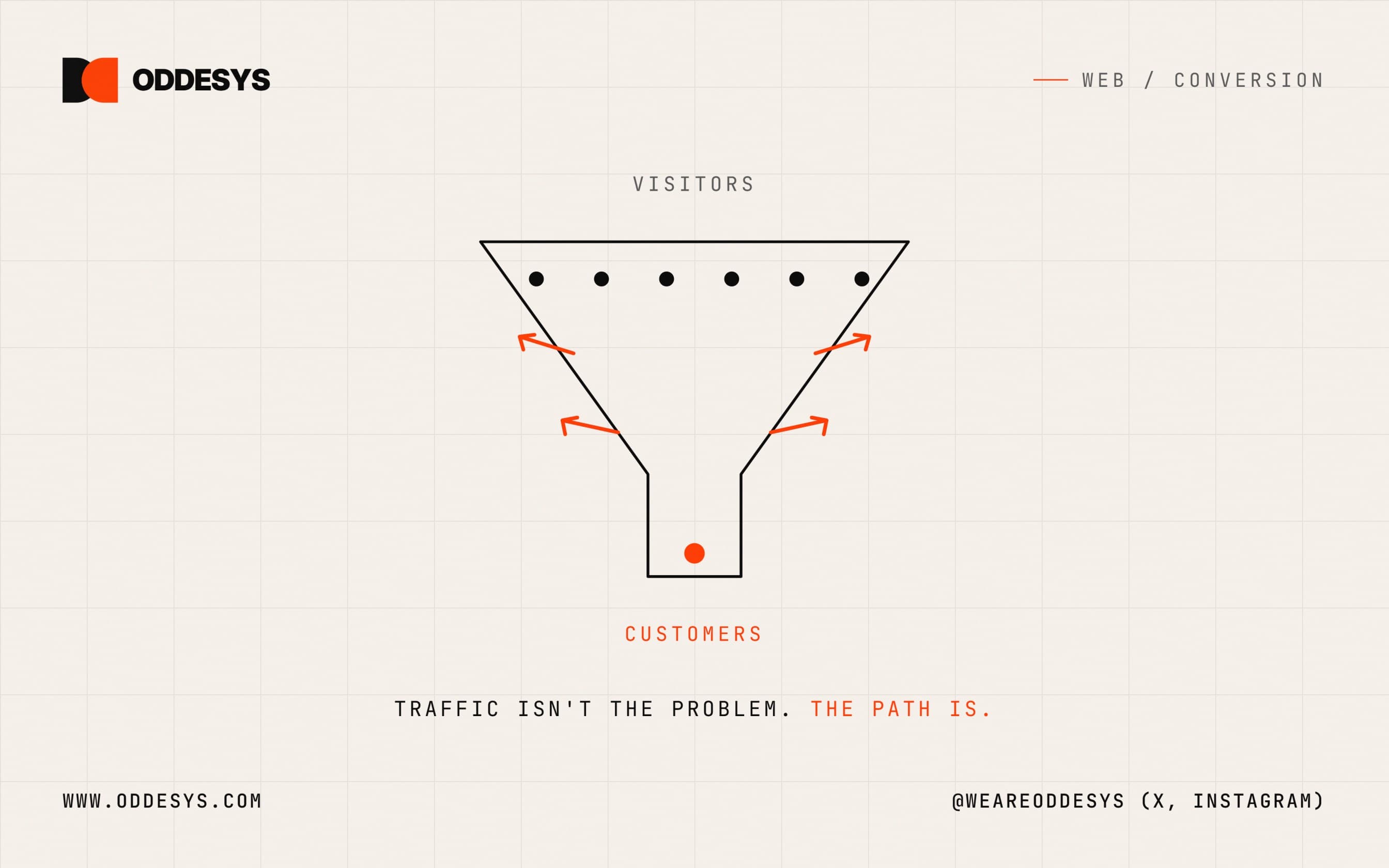
There is a particular kind of frustration reserved for the business owner whose analytics look healthy. Visitors are up. The ads are getting clicks, search is sending strangers your way, and the phone stays silent.
Here is the uncomfortable math. If your website converts almost nobody, more traffic just means spending more to deliver the same nothing. Double the visitors to a page that loses them and you have doubled your bill, not your customers. The numbers in your dashboard feel like progress, but they are only potential.
Traffic is what your marketing did. Customers are what your website did.
The good news is that this is usually the most fixable problem a website can have, because the trouble is rarely the paint. It is the path. Somewhere between the click and the sale, people are leaking out, and a leak always has a location. Your marketing is the water and your website is the bucket. Before you pay for more water, find the holes. On the sites we get asked to look at, they cluster in three places: the arrival, the middle, and the finish.
The arrival
A stranger lands on your page knowing nothing about you. They gave you a glance, and in that glance they need three answers: what is this, is it for someone like me, and what do I do next.
If any of those answers takes effort, they are gone. Not because they weighed you and decided against you. Deciding would take more attention than you earned. They drifted back to the search results and tapped the next name on the list, the one whose page said "We repair roofs in New York, free quotes this week" while yours was still warming up to "Solutions for the modern home."
Once the questions are answered, the next step has to be obvious. One clear action, visible before anyone scrolls. A page that presents six equally important buttons is a page hoping the visitor will do the deciding, and visitors do not accept that job.
Speed lives here too. A slow page is a locked shop with a note that says back in five minutes. A few people wait. Most assume something is broken and leave before your headline ever gets its chance. The quickest way to feel this is to open your own site on a phone, on cellular data, with mediocre signal. That is how most new customers meet you.
The middle
Suppose the arrival works. They know what you do and they are interested enough to scroll. Now they are deciding whether to believe you.
Belief is built from small details you have probably stopped seeing. Real photos of your work, your team, and your space tell a visitor there are actual humans here who will answer the phone. Stock photography tells them nothing, and everyone can smell it by now. Reviews with names and specifics persuade in a way a row of stars never will. A link that goes nowhere, an image that fails to load, a copyright year from three years ago: each one suggests nobody is minding the store, and people do not buy from a store nobody is minding.
There is a subtler leak here as well: the broken promise. Your page has to deliver whatever the ad or the search result offered. When someone clicks an ad for same day appliance repair and lands on a homepage about your company values, they do not hunt for the right room. They feel the wrong turn in their stomach, they leave, and your ad budget paid for the trip.
The finish
The cruelest leaks are at the end. The visitor believes you. They are ready to act. And the site makes that act feel like paperwork.
A contact form with twelve required fields when three would start the conversation. A checkout that demands an account and a password from someone who only wanted to buy one thing. A surprise on the final screen: a shipping cost that appeared from nowhere, a request to call for pricing after ten minutes of effort, a confirmation page that just spins. Every extra step asks a stranger to push through friction on your behalf, and strangers owe you nothing.
Then there is mobile, where most of your visitors actually are. Take out your own phone and do the exact thing you want customers to do. Fill in the form with your thumbs. Tap the buttons. If you catch yourself pinching and zooming to hit a tiny link, every visitor is doing the same dance, and none of them love your business enough to finish it.
Change one thing, then watch
Once you see the leaks, the instinct is to commission a full redesign. Resist it.
A redesign changes a hundred things at once, which means you learn nothing. If inquiries rise, you cannot say which change did it. If they fall, the culprit is hiding among a hundred suspects. Redesigns also have a habit of discarding the parts that were working, because nobody knew they were working. We have watched businesses pay real money to get measurably worse, with no way to trace why.
The discipline that fixes conversion is smaller and much less glamorous. Write your numbers down before you touch anything: visits, inquiries, sales, for every page that matters. Then change exactly one thing. Rewrite the headline so it says what you do in plain words. Cut the form to three fields. Swap the stock photo for a real one. Watch for a week or two. If the number moved the right way, keep the change. If it did not, put it back and pick the next hole. Either way you learned something true about your customers, which is more than a redesign will ever teach you.
The loop is boring and cheap, and it compounds. A few patched holes later, the traffic you already pay for starts turning into customers, and every marketing dollar after that works harder than the one before it.
If you would rather hand the hunt to someone who does it every week, this is some of our favorite work, because the wins come fast and you can see them in the numbers. We will walk through your site the way a first time visitor does, show you exactly where people fall out, and fix the few things that matter, no redesign required. You can find us at oddesys.com.