App or Website: Which Should You Build First?
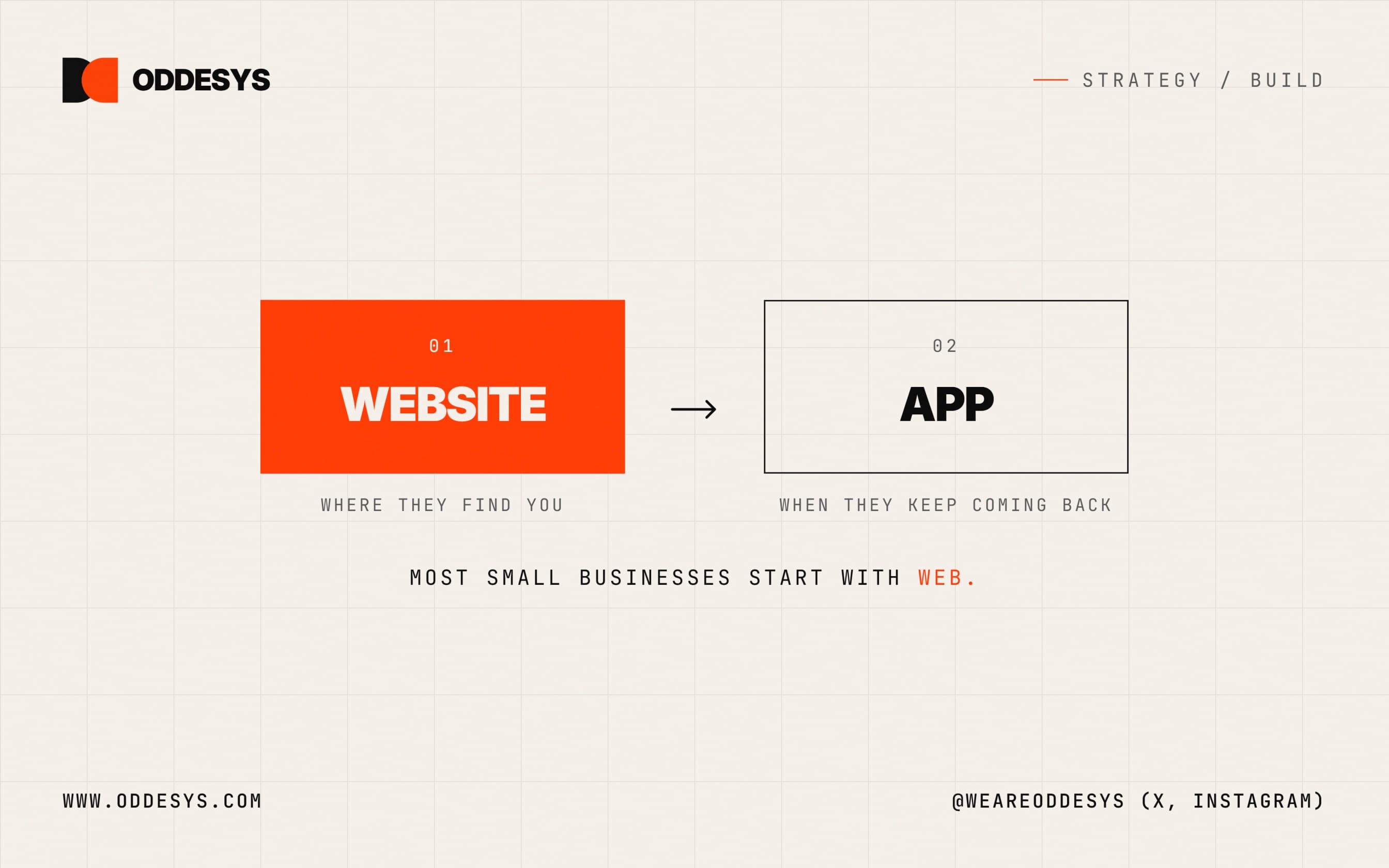
The app versus website debate is the wrong question. What matters is where a new customer first meets you and what they need to do in that exact moment. Get that right and the build order decides itself.
Ask ten people whether your business needs an app or a website and you will get a technology debate. Native versus web. App stores versus browsers. All of it interesting, none of it the point.
You are not in the technology business. You are in the business of being chosen. A customer hears about you, looks you up, decides whether to trust you, and either picks you or picks someone else. Everything you build exists to make that sequence go your way.
So the real question is not which technology to buy. It is this: where does a new customer first meet you, and what do they need to do in that exact moment? Answer that and the build order stops being a debate.
Most first meetings happen on the open web
Picture a barber opening a second chair and wanting more bookings. His next customer is standing on a sidewalk typing "barber near me" into her phone. She checks the map listing, glances at photos, looks for prices, maybe reads two reviews. If she can book in under a minute he wins, and at no point in that sequence will she download anything.
That is the shape of discovery for most local and service businesses. People find you through search, maps, and recommendations, and the web is where all three roads end. When a friend mentions your name at dinner, the listener does not open an app store. They type your name into a browser, and whatever loads becomes their first impression of you.
There is a newer version of the same meeting, too: AI assistants now answer "who should I call" questions by reading the open web, and a business that lives only inside an app is invisible to them.
If your customers discover, check, and decide before they ever buy, the website goes first. Not because apps are bad, but because the meeting happens where the website is.
When the app deserves to go first
Apps are for relationships, not introductions. They make sense when the people using them already know you and need you often. Four signals tell you that is your situation.
They come back constantly. If your customers use you daily or weekly, the browser becomes a chore and an icon becomes a habit. Frequency is the single strongest argument for an app.
They need you on the go. A courier firm dispatching forty drivers does not need a beautiful homepage. It needs a tool that works with one hand in a parked van, with gloves on, in bad light.
They live behind a login. When everything valuable happens inside an account, like a clinic sharing results with existing patients, the public web matters less than the private experience.
They genuinely benefit from notifications. Not marketing pings, but messages with stakes: your driver has a new pickup, your results are ready, your appointment moved. If a missed message costs your customer something, notifications are a feature, not a nuisance.
Notice what those four share. In every case the audience already exists. The courier firm knows its drivers by name, and the clinic already has patients. Nobody in those stories has a discovery problem, so nobody is using an app to solve one.
The trap that eats budgets
The expensive mistake is building an app for an audience that does not exist yet. A new business has no regulars, no logins, nothing urgent to say. It has strangers who need convincing, and strangers will not install anything to be convinced.
Nobody downloads an app to find out whether they like you.
The app store is a terrible place to be discovered. People search it for things they already want, usually from brands they already know. Every install you do win then fights for a place on someone's home screen against their bank, their messages, and their photos.
And that kind of failure is quiet. The app does not crash. It simply stops being opened, and months later you realize you paid app prices for a problem a good booking page would have solved.
The money is not even the worst part. The worst part is the time you spent not fixing your actual problem, which was that strangers could not find you.
The middle ground most people skip
Here is what has changed: the gap between a website and an app is much narrower than it used to be. A well built web app can be installed to a home screen with its own icon. It can send notifications and keep working on a weak connection.
It can take payments, handle accounts, run bookings and member areas. Your customers get most of the app experience without visiting an app store, and you get one codebase instead of three. One caveat belongs in writing: platform limits exist, and some notification behaviors and deeper hardware access, especially on iPhones, still belong to native apps.
For most businesses, that middle ground covers years of growth. You launch on the web, where new customers actually meet you, and as regulars accumulate you add the installable layer, the logins, the notifications.
The day you finally need a native app, you will know exactly which screens people use, because they will have been using them all along. You will be building from evidence instead of hope.
Let real usage call it
So the rule is plain. Start with the cheapest thing that proves people want what you offer. For almost everyone that is a fast, clear website where a new customer can understand you and act in a single visit. It is your storefront on the street people already walk down.
Then watch what happens. If customers return so often that opening a browser feels like friction, if they ask whether there is an app, if your team needs the tool in the field, not at a desk, those are signals from real usage. At that point the app stops being a gamble and becomes the next step, ordered by your customers rather than your nerves.
And if nobody is coming back yet, an app would not have fixed that. It would only have hidden the same empty calendar behind a download screen.
We build both, websites and apps, so we have no horse in this race. What we care about is the order, because we have watched the wrong sequence burn a budget and the right one feel almost easy. If you are standing at this fork, tell us where your customers first meet you and we will tell you plainly which build goes first. You can find us at oddesys.com.