Anyone Can Build 80% of an App Now. The Last 20% Is the Whole Job.
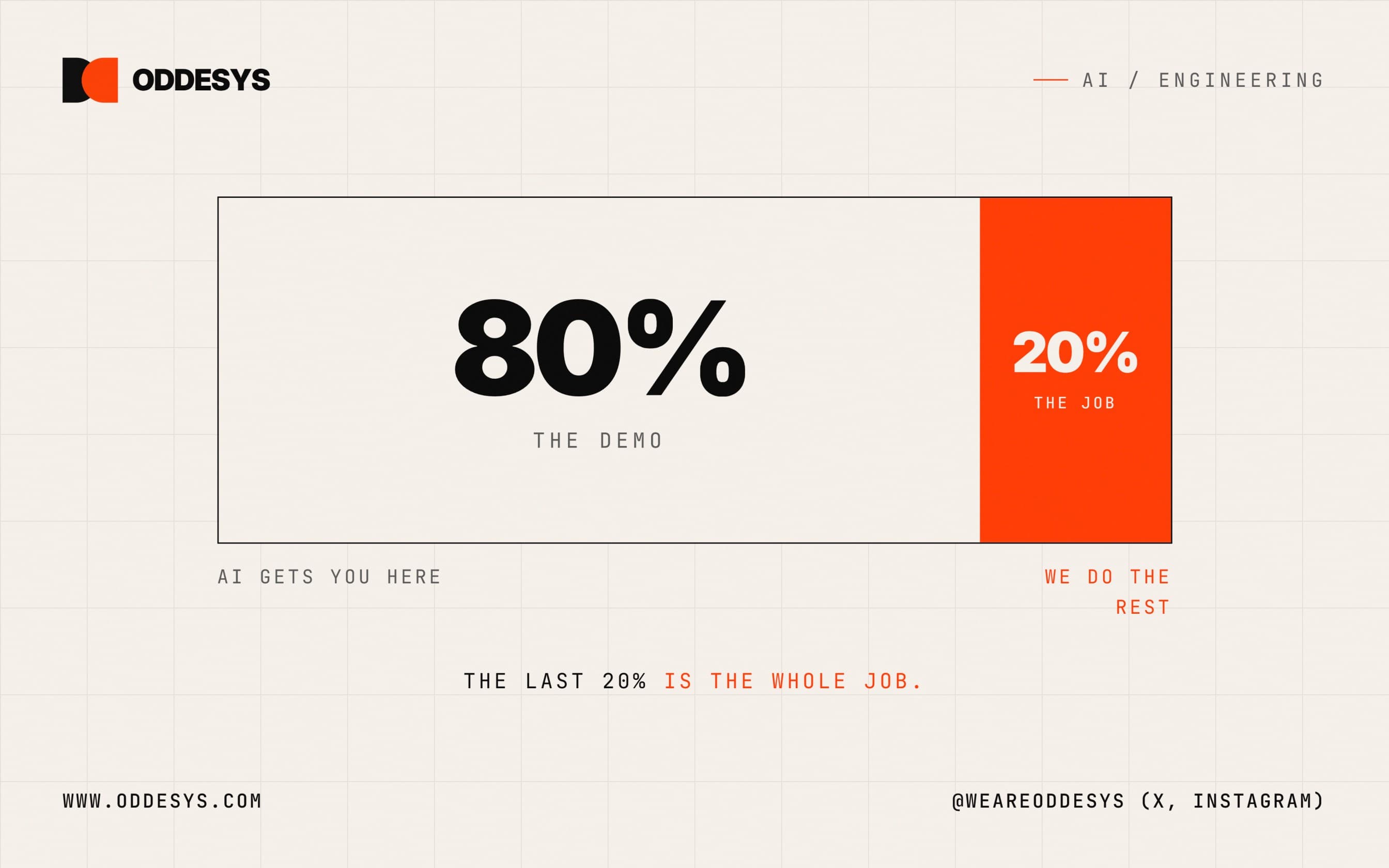
AI can take almost anyone from idea to a working demo in a weekend. That is real, and it is wonderful. It is also where the easy part ends. The last 20%, the part that does not demo, is where apps actually succeed or quietly fall apart.
Something genuinely new happened in the last couple of years. A person with no engineering background can now describe an app to an AI and watch a working version appear. People are calling it vibe coding, and the snobbery around it misses the point. It is real, it is fast, and it has put building software in reach of people who were locked out of it forever.
We are not here to sneer at that. We use AI heavily ourselves. What we want to talk about is the part nobody posts a video of. The moment the weekend demo meets the real world.
Because here is the pattern we see again and again. AI gets you to eighty percent astonishingly fast. Then the last twenty percent arrives, and that twenty percent turns out to be the entire job.
The 80% is real, and it is genuinely great
Let us give the good part its due.
For a prototype, an internal tool, a quick test of an idea, vibe coding is often all you need, and that is fantastic. If you want to see whether a concept feels right before spending real money, building a rough version in a day is a far better use of time than writing a twenty page spec.
We actively encourage people to do this. Come to us with a scrappy thing you built yourself and a clear sense of what worked, and you have saved everyone weeks of guessing. The 80% is a brilliant way to think, to learn, and to start.
The trouble only begins when the 80% gets mistaken for the finish line.
What lives in the last 20%
The demo works because it only ever does the obvious thing, the way you expected, with you as the only user. Reality is none of those.
The edge cases. What happens when someone enters a date in the wrong format, loses connection mid action, taps the button twice, or pastes an emoji where a name should go. A demo handles the happy path. A real product handles the hundred unhappy ones, and that handling is most of the actual code.
Security. This is the scary one. AI generated code very often looks correct and quietly leaves the door open. Data anyone can read, inputs nobody checked, keys sitting in the open. It runs perfectly and it is a breach waiting to happen, and you will not see it in a demo because nothing is attacking a demo.
Scale. The thing that is instant with one user and ten records can crawl or fall over with a thousand users and a million records. The fix is rarely more prompting. It is the unglamorous engineering of how data is stored, queried, and served, which is exactly the part the quick build skips.
The hand off and the long life. Software is not finished at launch, it is born at launch. It needs to be understood, fixed, and changed for years. Code that was conjured in a weekend and never structured to be maintained becomes a wall the moment anything needs to change, and everything needs to change eventually.
The first 80% answers can it be built. The last 20% answers can it be trusted with real customers, real data, and real money. Those are not the same question.
How to tell which 20% you are in
This is the genuinely useful part, so we will be specific.
If you are testing an idea, building something only you or a few colleagues will touch, or making a throwaway to learn from, vibe coding is not just acceptable, it is the smart move. Do not hire anyone. Build it yourself and enjoy it.
If real customers will depend on it, if it touches money or personal data, if it needs to stay up and stay safe and keep growing, you have crossed into the last 20%. That is the point where the value of people who do this for a living stops being optional, not because the building is hard, but because the not breaking is.
The mistake we see most is shipping the 80% to real customers and discovering the missing 20% the expensive way, through a breach, an outage, or a rebuild that costs more than doing it properly would have.
How we work with the 80%
At Oddesys, AI built prototypes have quietly become one of our favorite ways for a project to start. Someone arrives with a working sketch of their idea, and that sketch is worth more than any brief, because it has already shown what matters and what does not.
From there our job is the 20%. We take the proven idea and make it real. The edge cases handled, the security actually checked, the data built to scale, the code written so it can live and change for years. We use AI through all of it, the same way we always do, to move faster on the parts that do not need human judgment, while people own the parts that do.
The future is not people versus AI built software. It is people using AI to get to eighty percent in a weekend, and knowing when the last twenty percent is the part that decides whether the thing survives contact with the real world.
If you have built the 80% and you are wondering what it takes to make it real, that is one of our favorite conversations to have. Bring us your weekend demo at oddesys.com.