How We Ship in Two Weeks or Less
We are a small team, but we lean hard on AI and use our time well, so speed does not cost us quality. Here is how the two week timeline actually works, week by week, and what moves it.
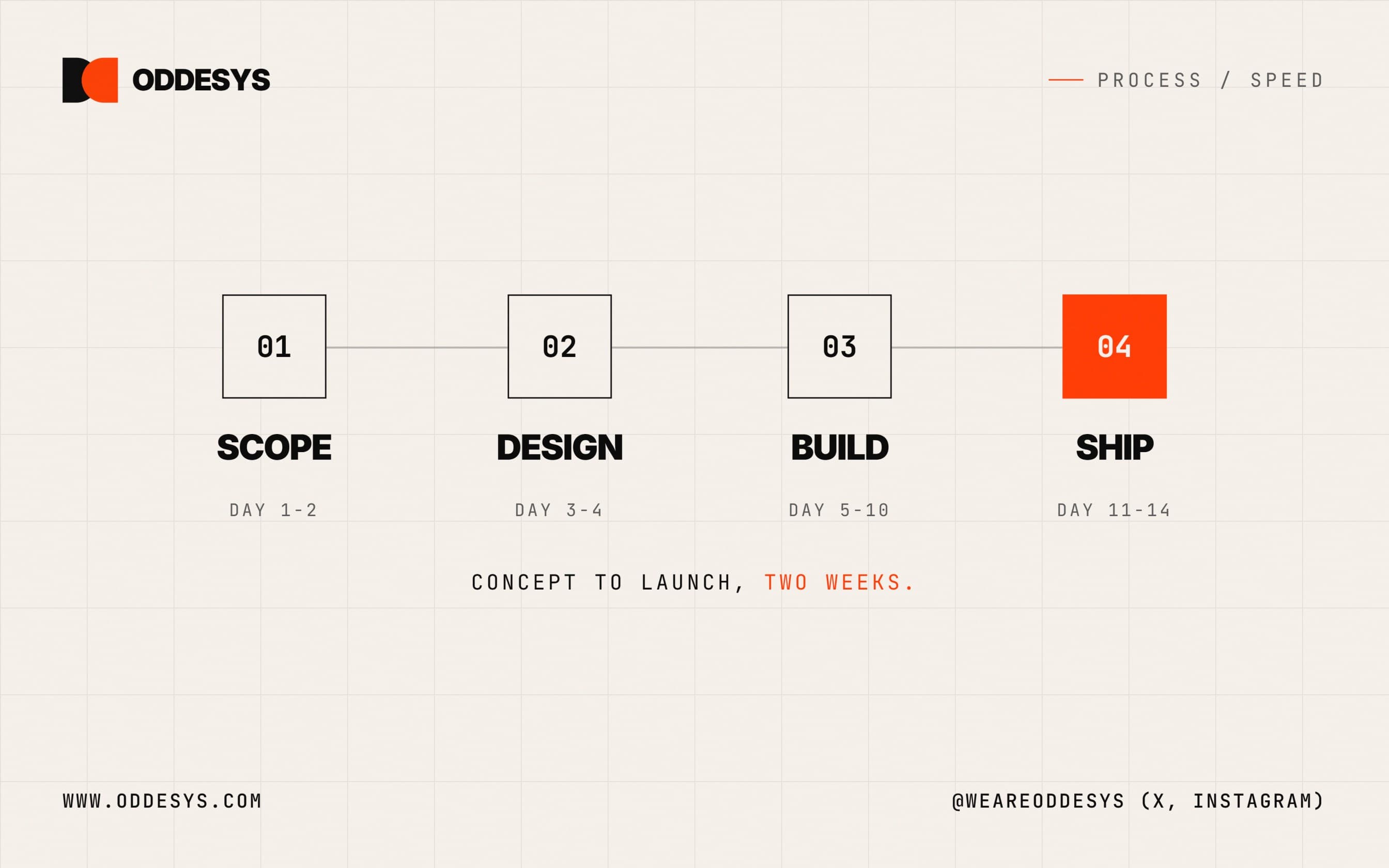
Most studios treat speed and quality like two ends of a slider. Push for faster, and something has to give, usually the testing, the polish, or the parts nobody sees until they break. We do not think that is true. In our experience, slow projects are rarely slow because the work is hard. They are slow because nobody decided what to build, and the team waited.
We are a small team at Oddesys. That sounds like a disadvantage for speed, and a few years ago it would have been. Today it is the opposite. A small team that uses AI properly and respects its own time moves faster than a large team that does neither, because there is no coordination tax and no waiting around.
Here is how a two week build actually works for us, and where that number bends.
What the timelines really look like
We will be plain about this, because vague promises help nobody.
A simple web app or marketing site usually ships in about a week. A standard web build, the kind with real features and a few moving parts, lands around two weeks. Bigger, more complex products take longer, and we say so on day one rather than discovering it in week three.
Mobile apps need more time than the web. App store review, device testing, and the native edges all add days that no amount of AI removes. AI integrations are similar. The model is the easy part. The plumbing around it, the guardrails, and the testing are where the real time goes, and rushing that is how you ship something embarrassing.
UI/UX is the one part that is almost never the bottleneck for us. Design moves in step with the build instead of blocking it, so by the time engineering needs a screen, the screen is ready.
A two week number is only honest if you are also honest about when it does not apply. Web is fast. Mobile and AI need room. We would rather tell you that up front than apologize for it later.
Where the AI leverage actually comes from
When we say we lean on AI, we do not mean we ask a chatbot to write the app and ship whatever comes out. That is how teams generate a week of cleanup, not a week of progress.
The leverage shows up in the unglamorous middle of a project. The first draft of a component, the boilerplate, the test scaffolding, the migration script, the second opinion on an architecture choice at two in the afternoon when there is nobody else to ask. AI handles the parts that eat hours but need no judgment, which frees the team to spend its hours on the parts that do.
Every line still gets read by a person. Nothing reaches your users because a model felt confident about it. The AI makes the team faster at the work it is already good at. It does not replace the part where someone who knows what they are doing decides whether the code is right.
That distinction is the whole game. Used well, AI compresses the timeline without touching quality. Used badly, it quietly trades quality for the appearance of speed, and you pay for it after launch.
What proper resource utilization means
The second half of our speed is less exciting and just as important. We do not let work sit.
In most projects, the slow part is not the typing. It is the gaps. A decision that waits three days for a meeting. A design that sits in review. A question that could have been answered in an hour but waited until the next standup. Add those gaps across a project and they easily outweigh the actual building.
So we close the gaps. Decisions get made the day they come up, not the week they come up. Design and engineering run in parallel rather than handing off in a line. Feedback loops are short and direct, usually one conversation instead of a thread that takes two days to resolve. The team is small enough that everyone knows the full picture, so nobody is blocked waiting to be told what the rest of the project is doing.
None of this is a trick. It is just refusing to waste the hours, which most projects do without noticing.
What to expect, week by week
For a standard two week web build, here is the honest shape of it.
Days one and two. We pin down what we are building and, just as important, what we are not. You leave this stage with a clear scope and a real plan, not a vague brief. This is where most of the future speed is bought, because every question we answer now is a question that does not stall us later.
Days three and four. Design and the first real screens. UI/UX takes shape while the foundation gets laid underneath it. You start seeing the actual thing, not a slide deck.
Days five through ten. The build. Features come together in parallel, with working updates you can look at along the way rather than a single reveal at the end. Code is typed, tested, and reviewed as we go, not patched together and cleaned up later.
Days eleven and twelve. Polish, testing, and the details. Performance, edge cases, the small things that separate a finished product from a demo. This is the stretch most rushed projects skip, and it is the stretch we protect.
Days thirteen and fourteen. Launch. Deployed, monitored, and watched closely in the first days while real people start using it. We do not ship and disappear.
A simple site collapses this into about a week. A mobile app or an AI build stretches it, mostly in the testing. Either way, you get a real date at the start, and we hold ourselves to it.
The honest version
Two weeks is our average, not a slogan. It works because we are small enough to move without friction, disciplined enough to decide quickly, and practical enough to let AI carry the work it carries well while people own the work that needs a person.
If you have a web, app, AI, or UI/UX project and you want a straight answer about how long it would actually take, that is exactly the conversation we like having. You can find us at oddesys.com.