Where the Hidden Costs Hide in a Software Project
The quote is the smallest surprise in a software project. The real budget shocks arrive mid-build, from scope creep, third-party fees, and the work nobody mentioned. Here is where they hide and how to budget so none of them ambush you.
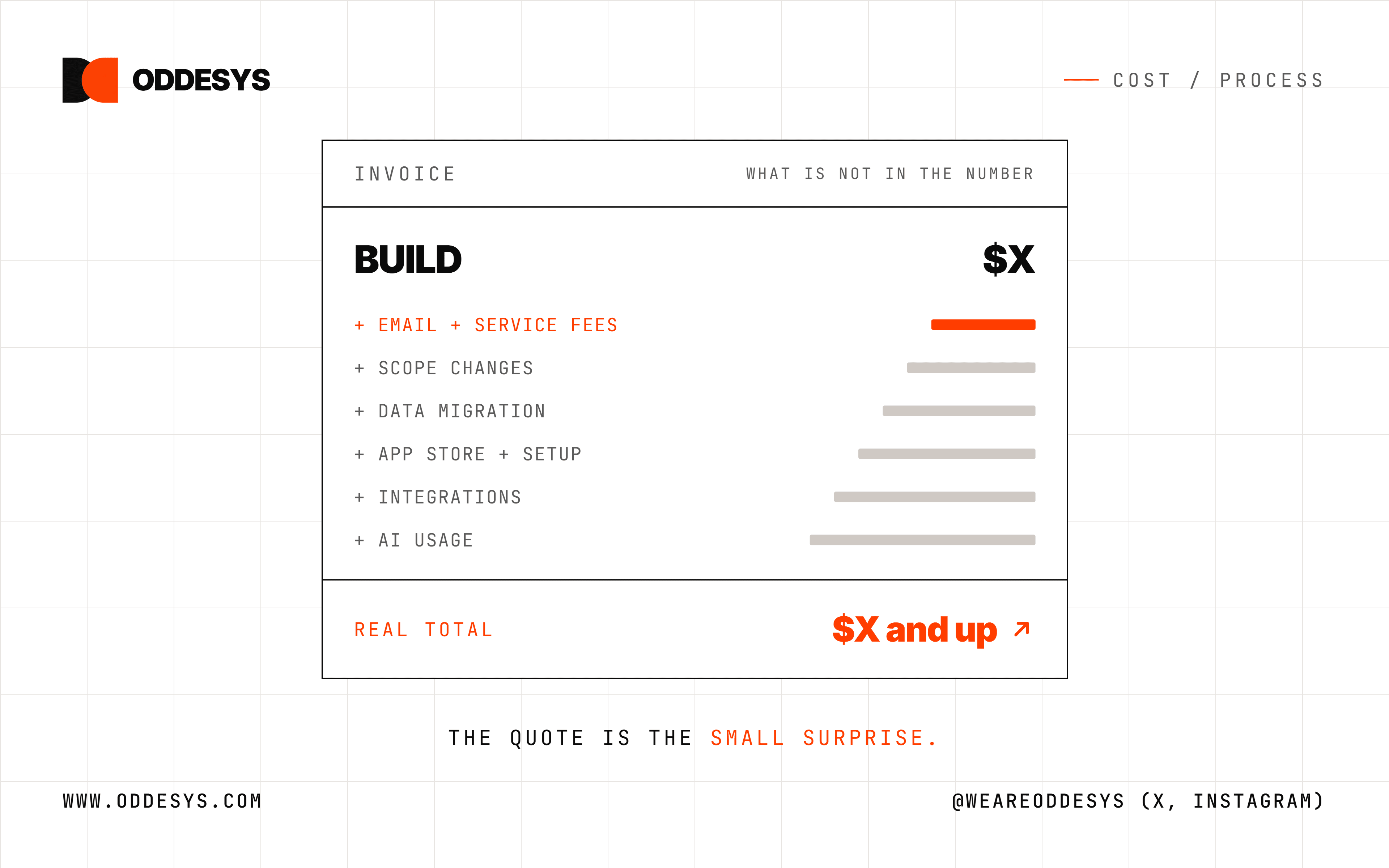
Business owners brace for the quote. It is the cheap part. You worry about it, negotiate it, sign it off, and assume the painful part is over. It is not. The quote is the most honest number you will see in the whole project, because it is the one everyone studied before anyone got attached.
The costs that actually hurt show up later, in the middle of the build, when the work is half done and stopping is not an option. They are smaller individually. They arrive one at a time, each one reasonable on its own, and they add up to a number nobody put on a slide.
None of this is a scam. It is the gap between what a fixed quote can predict and what a real project turns out to need. The good news is that almost every one of these surprises is known in advance by people who have built before. So here is the map. Everything below happens during the build; the recurring bills that start after you launch are a separate list for another day.
Scope creep is mostly your own good ideas
The biggest overrun on most projects is not the developer padding the bill. It is you, having better ideas as the thing becomes real.
This is not a flaw. Seeing a working screen is the first time the product stops being a guess, and of course you notice things. A field that should be there. A step that feels clumsy. A whole feature that was obvious the moment you could click around. Every one of those is a fair thought. The problem is that each one is also work, and work that was not in the number you signed.
The half-sentence that costs a week. "Can we also let them upload a photo?" sounds like nothing. Underneath it sits storage, file size limits, what happens on a bad connection, and how it looks on a small screen. The ask took four seconds. The build takes days.
The fix is not to freeze every idea. It is to make the trade visible. A good team will tell you, before they start, what a change will cost in time and money, and let you decide. Budget a change buffer on purpose, say ten to fifteen percent of the project, and treat it as yours to spend on the ideas worth having. Then the good ideas stop feeling like emergencies.
The fees that are not on your invoice
A lot of what makes software work is rented from someone else, and those rents do not appear in a development quote because they are not development.
Sending email costs money. Password resets, receipts, the "thanks for signing up" note. At small volume it is a few dollars a month. It is still a bill that did not exist when you imagined the app as a one-time price.
Texts, maps, and payments take a cut. A verification code is pennies each. A map on your page is metered by the view. Taking a card payment costs a percentage of every sale, forever. None of these are optional if your product needs them, and none of them belong to your developer.
The AI feature has a meter running. If your product calls an AI model, you pay per use, and that cost scales with how popular the feature gets. Success makes this bill grow, not shrink.
Ask for these to be listed before you start. Any experienced team can sketch your monthly running cost at launch and at, say, a thousand users. It will not be exact. It will keep the recurring bills from arriving as a surprise the month after launch.
The work between the screens
The picture you carry in your head is screens. The cost you did not picture is everything connecting them, and the work of moving your real life into them.
Integrations are where time goes to hide. Connecting your app to your booking system, your accounting tool, or your CRM sounds like flipping a switch. In practice every outside system has its own rules, its own quirks, and its own ways of breaking, and bending two systems to agree is some of the slowest work in any build.
The screens are what you are buying. The plumbing between them is what you are paying for.
Your data has to move, and it is messier than you think. If you already run on spreadsheets or an old tool, that history has to come across. Real business data is full of duplicates, blanks, and the same customer entered three slightly different ways. Cleaning and moving it is a real project, sometimes a large one, and it is almost never in the headline quote.
Content is a job, not a footnote. A site needs words, photos, and product details, and "we will write it later" is how launches slip by a month. Either you produce it, which is your time, or someone produces it for you, which is a line item. It is never free.
Design is a conversation with a budget
A quote often covers the design getting made. It quietly assumes you will mostly like it the first time. Real design is rounds, and rounds cost.
The first version is a starting point, not a verdict. You react, the team adjusts, you react again, and that loop is how good work happens. But every loop is hours. Most teams build a fixed number of revision rounds into the price, and going past them is extra. That is fair, as long as you know the number before you start spending it.
The way to protect this budget is to give sharp feedback early. "The headline is burying the price, and trust matters most to my buyer" moves a design forward. "Make it pop" buys you another expensive round that lands in the same place. Clear reactions are the cheapest design decisions you will ever make.
The launch is its own small project
Getting the thing live is a phase people forget to budget, because from the outside it looks like pressing a button.
App stores have a toll and a queue. Apple charges a yearly developer fee and reviews every app before it goes live, which can add days, sometimes with a rejection and a second wait. Google has its own fee and rules. None of this is hard. All of it takes calendar time you should not discover at the end.
Infrastructure has to be set up, not assumed. Servers, domains, security certificates, the address people actually type. It is a day or two of careful work that does not feel like product, so it tends to fall out of the estimate and back in as a surprise.
The cure for the whole list is one habit: ask, before you sign, "what is not in this number?" A team worth hiring will answer plainly, because they have seen every one of these arrive before. A team that waves the question away is not saving you money. They are moving the surprise to a worse time.
At Oddesys we put the running costs, the change buffer, and the launch steps on the table before the build starts, because a budget that hides things is not a kindness, it is a delayed argument. If you want a clear-eyed read on what your project will really cost from quote to live, that is a good first conversation to have. Email us at hello@oddesys.com or come find us at oddesys.com.