Stock Photos Are Quietly Telling Visitors You Are Not Real
A smiling team in a glass office that is not yours does not build trust. It quietly tells visitors you might not exist. Real photos of your work and your people do the opposite, and a phone is enough to take them.
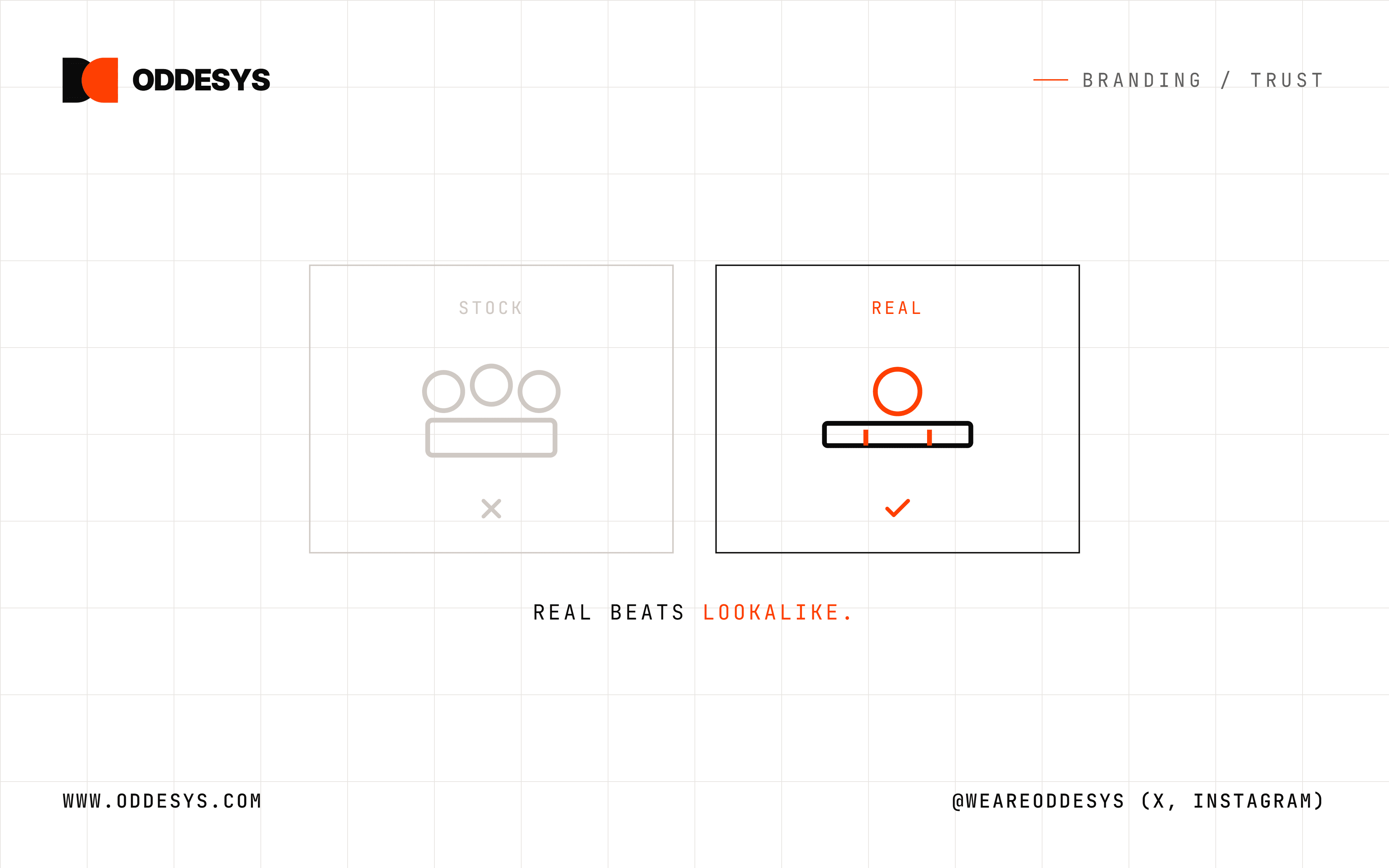
You have seen the photo. Four people in matching smiles around a laptop, pointing at a screen nobody is looking at, in an office with more glass than any real business can afford. Or the handshake. Or the headset woman gazing into the middle distance, ready to solve a problem she clearly does not have.
You picked it because it was clean, it was free, and it filled the space. What you did not notice is that your visitor has seen that exact photo on forty other sites this month. Their brain does not read it as a friendly team. It reads it as a placeholder. As a site that has not bothered to show you anything true.
Stock photography is not neutral. It is a small, repeated signal that you might be generic, that you might be padding, that you might not even be a real place with real people doing real work. And it is one of the easiest signals to fix, because the fix is already in your pocket.
What a stock photo actually says
A visitor lands on your site to answer one question fast. Are these people real, and can they do the thing I need? Everything on the page is evidence for or against. Photos carry a lot of that weight because the eye gets to them before the words.
A generic stock image is weak evidence at best and bad evidence at worst. At best it says nothing, a blank where proof should be. At worst it actively undercuts you, because a certain kind of visitor has learned that the businesses hiding behind stage-managed strangers are often the ones with the least to show.
The recognition problem. The most popular stock photos are popular because they are free or cheap, which means they are everywhere. Your competitor down the road may have the same hero image. A buyer who has shopped around will literally recognize it, and the moment they do, both of you shrink in their mind.
The mismatch problem. A plumber in a small town puts a photo of a gleaming corporate lobby on his about page. A three-person agency shows a packed open-plan floor of twenty. The picture and the reality do not line up, and people feel that even when they cannot name it. It reads as a costume.
The absence problem. When every image is a stranger, the visitor never sees the actual thing. Not your shop, not your van, not your team, not your work. They leave knowing what generic professionalism looks like and nothing about you. You have spent the most valuable real estate on the page saying nothing.
A stock photo fills the space where proof was supposed to go. It is not a picture of your business. It is a picture of the fact that you did not show one.
None of this means a single stock image will sink you. It means stock is a cost you are paying without knowing it, in a currency that matters more than you think. Trust.
Real photos do the one job stock cannot
The opposite of a stock photo is not a better stock photo. It is a true one. A real image does something no purchased image ever can. It proves you exist and shows the visitor what they are actually buying.
Show your team. Not a posed lineup against a brick wall, just the actual humans who will pick up the phone and do the work. A face that matches a name on the about page turns an anonymous website into a small group of people you could call. People buy from people, and they cannot buy from a stranger in a headset.
Show your work. If you build decks, the best photo on your site is a deck you built. If you run a clinic, it is your actual room, your actual chair, clean and lit well. If you make something, show it being made and show it finished. This is the photo that answers "can they do the thing" better than any sentence you could write.
Show your place. The shopfront, the workshop, the van with your name on it, the desk where it happens. A real location grounds the whole business. It tells a nervous buyer this is a real place, one that would still exist if the website went down.
The magic is not that these photos are beautiful. Many of them will be a little plain. The magic is that they are unfakeable. Nobody else on the internet has a photo of your team or your work, so the recognition problem disappears, the mismatch problem disappears, and the absence problem disappears. You are showing the one thing you have that no competitor can copy.
Where it matters most, and where it does not
You do not need to re-shoot your entire site. A handful of true images in the right spots does almost all of the work. Three places earn the effort.
The hero. The first screen sets the gut read for everything after it. If you can put one strong, real image here, your team mid-work or your finished product or your actual space, do it. This is the single highest-value photo on the whole site, because it shapes what the visitor thinks of you before they have read a single word. A generic image here does more damage than a generic image anywhere else.
The about page. This page exists to answer one question: who are you? Fill it with photos of strangers and it answers with people who are not you. Real faces, real names, a real building. This is the page where trust is won or quietly lost, and it is the easiest one to make honest. Even imperfect snapshots of the actual team beat polished pictures of nobody.
The proof. Anywhere you are asking the visitor to believe a claim, a real photo backs it. The job you finished. The before and after. The product in a customer's hands. Words make claims. Photos make claims credible.
And here is the relief. There are spots where stock is genuinely fine, so do not torture yourself over them. Abstract or decorative backgrounds, a soft texture behind a section, a small icon-style illustration, a map, a generic image for a blog post about a broad idea. These are wallpaper, not evidence. Nobody decides whether to trust you based on the texture behind your pricing table. Save your energy for the three places above and let stock fill the rest.
The rule is simple. Where the image is asked to prove something, it must be real. Where it is only decoration, stock is allowed.
A phone is genuinely enough
Here is the part that surprises business owners. You do not need a photographer, a studio, or a budget. The phone in your pocket shoots better than the cameras that took most of the marketing photos you grew up admiring. What you need is not gear. It is a little intention and an hour.
Light beats everything. The one thing that separates a good phone photo from a bad one is light, and the best light is free. Shoot near a big window or outside in soft daylight, early or late, not harsh noon sun. Put the light on the subject, not behind it. Get this right and your phone does the rest.
Clean the frame. Half of looking professional is just removing clutter. Tidy the bench, clear the random box out of the corner, wipe the smudge off the glass. The eye reads a clean background as a competent business, the same way it reads a tidy van.
Shoot the truth, not a performance. The goal is real, not staged. Someone actually working beats someone pretending to laugh at a laptop. Hands on the tool, the real product, the genuine room. A slightly imperfect true photo outperforms a slick fake one every time, because the visitor is reading for honesty, not for polish.
Take ten, keep one. Photographers do not nail it in one frame and neither will you. Shoot the same thing from a few angles and distances, then pick the best. Hold the phone steady, tap to focus on the subject, and give yourself room to crop later.
Shoot wide, leave space. Capture a bit more than you think you need. A web designer can crop in, but cannot invent what was outside the frame. Extra room around the subject also gives space for a headline to sit over the image later.
An afternoon of this gives you a small library of true images, enough to fix the hero, the about page, and your proof. That is a better return on an afternoon than almost anything else you could do for the site.
The honest test before you publish
Before any image goes live, run it through one question. If a careful buyer studied this photo, would it make them trust us more, or would it tell them nothing? If the answer is nothing, it is not pulling its weight, and a true photo would.
Then a tougher one. Is this image actually us, or is it a costume? The corporate lobby, the team of twenty, the handshake in front of a skyline. If it is a costume, it is a small lie, and small lies on a website have a way of making people doubt the big claims too. People are good at sensing when a business is presenting a version of itself that does not exist, and once they sense it on the photos, they start checking everything else.
Real is not the same as perfect. Your true photos may be a touch plain next to the glossy strangers. Publish them anyway. Plain and true beats glossy and hollow, because trust is built on true, and the whole point of the page is to earn enough trust for someone to reach out.
When we build sites for clients, this is one of the first things we push on, and it is usually free to fix. We would rather spend an hour helping you shoot your real workshop than an hour picking the least generic stock photo on the internet. If you are looking at your own site wondering why it feels a little hollow, the strangers in the photos are a good place to start, and we are happy to look at it with you. Email us at hello@oddesys.com or start a conversation at oddesys.com.